For many people, it’s a dream to spend weekends fishing, cruising open water, or teaching kids to waterski. But here’s the million-dollar question – Should you buy a new or used boat? If this is your first time buying a boat, this question can feel overwhelming.
Picture boarding a shiny boat with the latest technology and a manufacturer’s warranty, or imagine buying a used boat at a much more reasonable price. Both seem right, but the right fit depends on your boating lifestyle and budget.
In this guide, we’ll cover the major differences between a new and used boat and figure out how each preference fits into the bigger picture of owning the right one.
New vs Used Boat at a Glance
Whether you’re an expert or a newbie, nothing thrills more than buying a boat. However, whether to buy a new or a used one always remains a big decision to consider.
Let’s compare these boats to understand the major differences before making the final decision.
| Factors | New Boat | Used Boat |
| Purchase price | Higher initial cost | More affordable |
| Depreciation | Faster depreciation, typically 10-15% in the first year | More stable value over time |
| Warranty | Layered factory coverage: structural hull and deck (commonly 5-10 years), components (typically 3-5 years), engine (usually 3 years) | Limited or none — check whether the structural warranty transfers, and whether a dealer warranty or service contract is available |
| Maintenance | Regular upkeep with aging | More frequent maintenance due to older parts and hidden issues |
| Technology | Cutting-edge technology and features | Older technology; getting it upgraded adds to the cost |
| Financing | Better financing terms; longer loan options | Higher financing rates; shorter terms |
| Insurance | Higher insurance premiums | Lower insurance premiums due to reduced insured value |
| Resale value | Quickly loses value during the initial years. | More stable as the depreciation flattens over time. |
| Best for | Seeking a specific configuration, keeping the boat for over 10 years, seeking warranty coverage, can pay the upfront cost | Budget conscious buyer, first-time boater, ready for a thorough inspection through a marine survey. |
Should You Buy a New or Used Boat?
One of the foremost decisions a buyer faces is whether the boat should be new or used. Let’s compare each vessel and consider the whole ownership picture.
Condition and Previous Ownership
If you’re looking for a boat with a clean and shiny surface and with no maintenance history, choose a new boat. Moreover, the manufacturer’s warranty gives you peace of mind, as you don’t have to pay out of pocket in case of an unexpected repair.
On the other hand, used boats might have some concerns related to the previous ownership that need to be analyzed carefully.
Technology and Features
New boats come with the latest features and upgraded technology. They include the latest navigation, robust fuel-efficient engines, and the latest safety gear. These amenities ensure good performance on the water.
On the contrary, used boats often come with older technology and features. Buyers need to spend extra to access those features and on regular engine maintenance.
Pricing and Long-Term Value
Though you don’t have to worry about the repair costs with new boats, they are relatively expensive and rapidly depreciate in the initial years. On the other hand, used boats save you a substantial amount and offer you a better value over time. However, you need to spend extra due to regular wear and tear and replacement of outdated parts.
Buying a New Boat: Pros and Cons
Buying a new boat is associated with several benefits and disadvantages. Let’s gain insight –
Latest Features and Modern Design
If you seek peace of mind and the latest features, a new boat is the perfect choice for you. There are no previous owners, no wear and tear, and no last-minute surprises, as you are buying a brand-new boat. You’ll get an upgraded GPS, better fuel efficiency, a modern engine, and cutting-edge safety features.
Factory Warranty and Dealer Support
It’s, in fact, one of the greatest benefits of investing in a new boat. The warranty indicates that many unexpected repair costs will be covered by the manufacturer. New boats usually carry three layers of coverage: a structural hull-and-deck warranty, commonly 5 to 10 years and sometimes advertised as “limited lifetime” to the original owner; a shorter bow-to-stern components warranty, typically 3 to 5 years; and a separate engine warranty from the engine manufacturer, usually 3 years and extendable. Read the exclusions, because “lifetime” coverage is almost always limited to the first owner and often capped.
Customization Options
With a new boat, you get the opportunity to customize it according to your preferences. If you need a boat of a specific color or layout and equipped with particular accessories, the customization options help you get the boat of your choice.
Higher Purchase Price and Faster Depreciation
You’ll have to pay more for a new boat than a pre-owned one. Thus, the higher purchase price can be a major issue for budget-conscious buyers. Moreover, new boats depreciate quicker. Its value drops in the first few years, which means you may not recoup the initial investment if you plan to sell it soon after buying.
Buying a Used Boat: Pros and Cons
Now that you’re finally ready to take the plunge and buy your boat, let’s find out the pros and cons associated with choosing a used boat.
Lower Purchase Price
Used boats are drastically cheaper than new ones and way more reasonable than they originally were. It saves you a substantial amount of money, as you can get a high-end model for the same budget. A used boat is a great opportunity for first-timers who’re figuring out what they need in their boat.
Reduced Depreciation
In a used boat, the previous owner has already endured the steepest depreciation; the boat you own is worth roughly what you paid for. Maintain it well, and you’ll be closer to the value over your ownership period than a new vessel would. In other words, when you buy a used one, you’re buying on the flat part of the depreciation curve.
Potential Maintenance and Repair Costs
Used boats are more vulnerable to wear and tear, which can lead to high maintenance and repair costs. Pre-owned boats might need servicing and parts replacement. Moreover, without a warranty, fixing the issues might end up being more costly than you anticipate. Thus, you need to spend more time vetting the boat to make sure it’s worth buying and mechanically sound before making the purchase.
Limited Warranty and Older Technology
If you buy a used boat, you’re often on your own for the cost, because factory coverage is limited or has already expired. Ask whether the structural hull warranty transfers to a second owner, and whether the dealer offers short-term coverage or a third-party service contract. It’s best to have a marine technician thoroughly inspect the engine. Also, ask for any maintenance records. Moreover, used boats may not include upgraded systems or design updates as found in new boats.
New Boat vs. Used Boat Cost Comparison in 2026
Buying a boat is one of the biggest decisions you’ll ever make. The new boat vs. used boat decision can mean a huge cost difference. So, let’s break down every cost so you can make the right choice for your budget.
Upfront Purchase Costs
Newer boats command higher purchase costs with the steepest depreciation in the initial years. The size of the savings on a used boat depends mainly on its age: a 3- to 5-year-old boat typically sells for 20-35% less than the same model new, and by 8 to 10 years the gap widens to 30-50%. It’s important to carefully inspect the condition of the boat before making any comparison.
Depreciation and Resale Value
There is significant depreciation initially when buying a new boat, typically 10-15% of its value in the first year, around 20-30% by year five, and 30-50% by year ten. After that, the curve flattens, and condition and maintenance history matter more than age. As the depreciation has already occurred in a used boat, it offers significant savings.
Pertaining to the resale value, it’s difficult to recoup the initial price because the depreciation is front-loaded. On the other hand, used boats are more stable as the depreciation curve flattens with time.
Maintenance, Insurance, and Financing Costs
You don’t need to worry about maintenance with a new boat during the initial years, and it may come with a manufacturer’s warranty. On the contrary, used boats may need earlier and more frequent servicing, and parts replacement comes out of your own pocket once factory coverage has expired.
Insurance usually costs more on a new boat simply because the insured value is higher, so a used boat of the same type is cheaper to cover. Be aware that older boats are more likely to be written on actual cash value rather than agreed value, so the lower premium can come with a weaker payout at claim time.
On financing, new and nearly new boats attract lower rates and longer terms, while older boats bring higher rates, shorter terms, and a larger down payment, and most lenders stop financing entirely somewhere around 15 to 20 years from the model year. Loan length depends as much on the amount borrowed as on the boat’s age, so a $35,000 loan usually maxes out around 10 years whether the boat is new or used.
Total Cost of Ownership
While determining your budget for a boat, consider more than just the buying cost. You’ll have to spend a significant amount on gas, insurance premiums, boat storage, regular upkeep, sudden repairs, registering your boat, and other associated operating expenses. Thus, it’s essential to take into account the total ownership cost before making the final decision.
How to Evaluate a Used Boat Before Buying
Before finalizing the boat, do some homework. Research the make and model of the boat you’re interested in.
Check the Hull and Structural Condition
- Carefully inspect the hull and look for any cracks or damage.
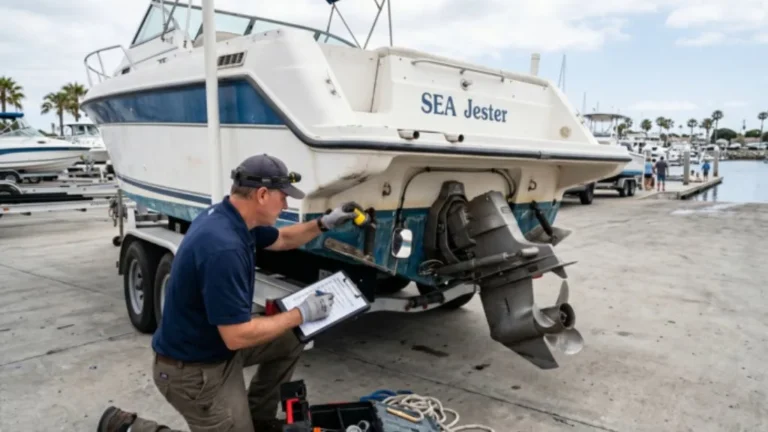
- Fine hairline or web-pattern cracks in the gelcoat are often cosmetic crazing — run a fingernail across them, and cosmetic cracks feel smooth. Because the transom carries the constant load of the outboard or drive, cracks there deserve a closer look, especially if they radiate from the engine mounts, feel like a step, or come with soft spots or staining.
- Check the bottom of the boat for any wear and tear or scratches.
- Ensure that the propeller is not bent or damaged.
Review Engine Hours and Maintenance History
Ask the seller how many hours the engine has been operating so far. Most US recreational boats run about 50 hours a season, so roughly 50 hours per year of age is normal — a four-year-old boat at about 200 hours is unremarkable. A gas outboard or sterndrive has a serviceable life of roughly 1,500 to 2,000 hours, so treat anything near or above 1,000 hours with caution and 1,500 or more as high. Diesels routinely reach 5,000 to 8,000 hours before a rebuild. Unusually low hours are worth asking about too, particularly in year-round boating states, because a boat that sat unused brings its own problems.
Determine if the boat has undergone any repairs, accidents, or insurance claims. Boats involved in accidents may have structural issues that’re often overlooked at first.
Inspect Electrical Systems and Electronics
Boats need robust electrical systems to function well. Thus, it’s important to check if the navigation lights and horn are working properly.
- Ensure all gauges are functioning well to avoid any deeper electrical problems.
- Switch on all electronics, including GPS and radios, to ensure they are in working condition.
Schedule a Marine Survey and Sea Trial
A sea trial is required to check the handling and stability of the boat. Carefully check how it navigates, its steering ability, and engine performance under load. It’s best to hire a marine surveyor who can save you thousands in unexpected repairs. A surveyor conducts a thorough inspection and helps you make a deal that feels right.
Ongoing Ownership Costs to Consider
Once you buy a boat, you’ll incur ongoing expenses to maintain your boat and make it all set for the open waters.
Storage, Fuel, and Docking Fees
You have to pay for marina or seasonal storage. Securing your boat at home can save you the storage and docking fees. Fuel is another ongoing expense that you need to take care of, especially when you go on a long expedition. Fuel cost scales with engine size rather than with the trip: a 250-horsepower engine burns roughly 25 gallons an hour at full output, while a pontoon burns around 5. Marina fuel also runs well above roadside pump prices, often by 50% or more. Filling a pontoon’s 25 to 50 gallon tank might cost $150 to $300, while a center console with a 150 to 200 gallon tank can run $700 to $1,200.
Registration, Maintenance, and Insurance
Common maintenance costs include engine service, oil changes, winterization, and much more. Regular maintenance helps you avoid costly repairs later.
Yearly insurance typically runs about 1-2% of the boat’s insured value, with roughly 1.5% a fair planning figure, depending on its usage and location. Premiums vary widely by state, boat type, horsepower, and where you keep the boat. Insurance gets you covered when you fund your boat, store it in a marina, and sail across busy waterways.
Boats must be registered with the state, but the renewal period is not the same everywhere. Florida registrations run annually and expire on the owner’s birthday; Texas registrations are valid for two years, and Georgia’s run for three. The costs vary by state and the size of your boat.
New vs Used Boats: Which Is Right for You?
Purchasing a new boat gives you access to the latest features and fewer issues, while you can get a high-end used boat within your budget. Let’s look at which option suits you best –
Best for First-Time Boat Owners
If it’s your first time buying a boat, a well-serviced used boat can be a good option. You’ll have to pay less compared to a new one. In other words, a used boat can be the right choice to learn basic navigation skills with a little investment. You can choose from a range of boat types and finalize one with the desired features.
Best for Experienced Boaters
The seasoned sailors very well know what features they need and the specific boat types suitable for their water activities. Being experienced, if you’re seeking a boat of a particular model and are not too bothered with the upkeep and repairs, a used boat is an ideal option for you. However, if you seek the latest technology and a manufacturer’s warranty, buying a new one is the better choice.
Best for Different Budgets and Boating Goals
Knowing your budget and boating goals beforehand can help you find the right option.
| Boating Goals | New Vs Used Boat |
| Recreational Boating | Pre-owned pontoon |
| Fishing | Used vessel with the right fishing gear. A new boat with upgraded features. |
| Water Sports | Both new and used, with robust engine, towing ability, and safety equipment. |
| Cruising | Prefer a new boat for modern amenities; choose a used one for better options within budget. |
| Long-term ownership | Factor in warranty, associated expenses such as repairs, maintenance, and insurance before making a decision. |
Common Mistakes to Avoid When Buying a Boat
Buying a boat is a crucial decision, and the last thing you want is to realize that you neglected something really essential. Here are some common mistakes that you need to avoid when buying a boat –
Choosing Based Only on Purchase Price
Shopping for a boat seems exciting, but it’s quite common to consider only the price of the boat while overlooking other expenses. These expenses include fuel, storage, maintenance, and insurance. You would lose more money buying a cheaper vessel that demands regular repairs.
Skipping a Professional Inspection
Regardless of how pristine a used boat looks, you could overlook certain issues during a quick inspection. Thus, you must hire a professional surveyor who can carefully inspect the hull, engine, and electrical parts. Considering an inspection before purchasing a boat can save you big problems.
Ignoring Maintenance and Operating Costs
While it seems tempting to look at the base price of a boat, it’s important to consider the additional costs of boat ownership. Maintenance costs include everything from routine engine service to hull cleaning. A common industry rule of thumb is to budget about 10% of the boat’s purchase price each year for upkeep, roughly $5,000 on a $50,000 boat. Treat that as a floor: saltwater use, older boats, and larger engines push it higher, and it does not include slip or storage fees. The operating costs include fuel charges, insurance premiums, storage, and winterization fees.
Final Thoughts
The decision between a new or a used boat comes down to your personal choices and budget. New boats offer cutting-edge technology, warranty, and personalization options, while used boats offer more value for money, a proven record, and an already flattened depreciation curve.
Don’t let a single factor dominate your whole decision. Consider the total ownership cost and usage patterns before making the final decision. Carefully evaluate and compare all factors to find a boat of your choice.
FAQs
Is it Better to Buy a New or Used Boat?
New boats are equipped with upgraded features and offer better personalization options such as color and layout. With a new boat, you can expect a clean and clear exterior with no unseen damage. However, you have to pay more than for a used boat. Moreover, if you’re learning how to drop anchor and navigate on the water, a used one is a better option.
What is The Best Age to Buy a Used Boat?
Age is a major factor in resale value, performance, and maintenance prices. Boats older than 10 years may offer good savings, but they also bring hidden repair charges along with them. Many buyers find the best value in boats roughly 3 to 7 years old, where the steepest depreciation is behind them, any transferable structural warranty may still be in force, and engine hours are typically still low. Treat that as a judgment call rather than a rule — a well-documented 10-year-old boat can beat a neglected four-year-old one.
Do New Boats Hold Their Value Better Than Used Boats?
New boats offer a higher upfront cost and a quick depreciation during the early years. Because the largest depreciation often occurs during the first year of ownership, used boats hold value better than new boats. So, for a lower entry point while still offering a good boating experience, buying used boats is worth it.
How Much Cheaper is a Used Boat Compared to a New Boat?
There is a remarkable cost difference between a new and used boat, and it depends mainly on age. A 3- to 5-year-old boat typically sells for 20-35% less than the same model new, and by 8 to 10 years the gap widens to 30-50%. Though affordable, used boats come with signs of wear and lack of upgraded technology.
What Should I Check When Buying a Used Boat?
Conducting a thorough inspection is essential when buying a used boat. Carefully check the hull for any cracks. Step inside the boat and inspect the floor for any spots. Check the seats for any wear and tear. Also, ensure that storage compartments function properly.
How Many Engine Hours Are Too Many On a Used Boat?
There are no specific engine hours that indicate a used boat is too old to buy. Usually, 1000 hours or more indicate that the engine needs to be inspected closely, and 1,500 hours or more is high for a gas engine. There is a possibility that a vessel with 700-800 hours and proper maintenance may be the better option than one with 300 hours that has never been serviced.