According to the U.S. Coast Guard’s 2024 Recreational Boating Statistics, 87% of drowning victims whose life jacket use was known were not wearing one. So, it is important to understand life jacket requirements and wear the right one. Wearing life jackets can save lives and help handle shock. Moreover, the requirements may vary depending on the boat type, size, federal laws, state regulations, and other factors. You have to comply with legal requirements to avoid fines. Here is a complete boater’s guide explaining all the rules you need to know, including legal requirements, age-specific regulations, Coast Guard-approved life jackets, types of life jackets, the number to carry, and requirements for water sports and other activities.
Understanding U.S. Life Jacket Requirements in 2026
U.S. life jacket requirements are a combination of both federal and state laws. You should understand both regulations.
Federal Boating Regulations
The U.S. Coast Guard specifies that every boat should carry one Coast Guard-approved, well-maintained, and properly sized life jacket for everyone on board. Wearable life jackets must be readily accessible; throwable devices must be immediately available. Moreover, it requires that children under 13 must wear one whenever the vessel is underway, unless they are below decks or in an enclosed cabin. Besides, boats 16 feet or longer should carry a wearable personal flotation device for each person and one throwable flotation device, such as a buoyant ring or cushion. Federal rules include just baseline safety standards.
How State Laws Can Differ
State laws impose additional rules for specific water activities, particular types of vessels, and kids. For example, states insist that boaters riding skis or wakeboards must wear a life jacket irrespective of the size of the vessel. It is mandatory for anyone riding a jet ski. States also govern life jackets for high-risk activities like tubing. Moreover, state laws may vary for different waterways like rivers, lakes, and the sea. Where a state has its own child life jacket rule, that rule applies instead of the federal under-13 rule — in Florida, for example, children under 6 must wear one on vessels under 26 feet while underway.
How Life Jacket Requirements Vary by State
The federal rules are the same across the country, but the state rules vary. Most states have some common requirements. Most states require that children wear a life jacket if they are not in an enclosed cabin. Inflatable life jackets are not approved for personal watercraft use, and many states also require a non-inflatable device for PWC riders. Life jackets are essential for everyone on board skis, tubes, and wakeboards. For whitewater paddling, Type III (Level 70) life jackets rated for that use are recommended. These are the basic requirements. If you want the exact requirements for your state, check the latest rules with your state authority before heading into the water. Make sure everyone on board follows the rules strictly.
A Note on Types and Levels
Federal regulations no longer use the Type codes — they simply say “wearable” and “throwable.” The Coast Guard removed the Type references from the carriage rules in 2014, and the Lifejacket Approval Harmonization rule that took effect in January 2025 stopped new Type classifications altogether. New jackets are labelled by performance Level — 50, 70, and 100 under the US rule — with icons showing water conditions, turning ability, and any prohibited activities. Offshore-style Level 150 devices exist in the international standard but were not included in the US rule. Type-marked jackets you already own remain legal as long as they are serviceable, and most gear in use still carries them, so the Types are explained below.
Who Must Wear a Life Jacket?
Age Requirements for Children
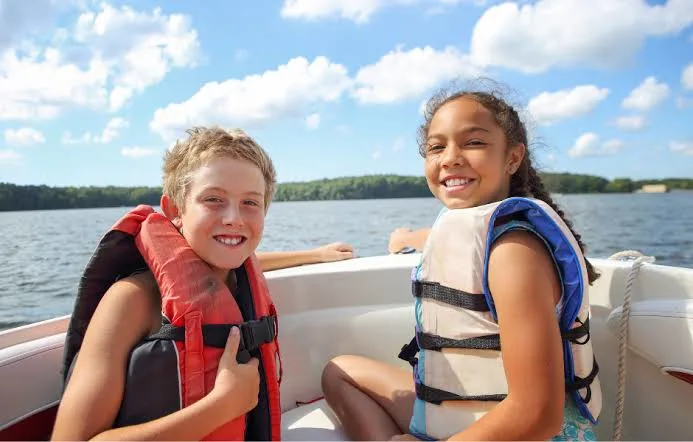
Life jacket requirements for children vary by state. Most states specify that kids wear a USCG-approved jacket of the right size while they are on a moving boat unless they are in an enclosed cabin. However, the minimum age requirements vary by state. It can be 6, 10, 12, 13, or 14. Where the state has no rule of its own, the federal default applies: children under 13 must wear one while the vessel is underway. Parents must check with the authorities what the current requirement is in the state they are sailing.
Adult Life Jacket Requirements
Unlike children, adults are not required to wear one all the time they are on board. However, during special activities, states require that adults wear life jackets mandatorily. All boats must have a USCG-approved life jacket matching the chest size and weight range printed on the approval label for everyone on board. They should be readily accessible and should be in good condition. There should be no tears or broken straps.
Rules for Personal Watercraft (PWC) Riders
For boaters operating personal watercrafts like a jet ski, it is mandatory to wear a USCG-approved life jacket. The life jacket should fit their chest size and weight perfectly. It should be fastened securely. Inflatable life jackets are not approved for PWC use — their approval label says so, and federal law requires a life jacket to be used within the conditions on its label. Many states, including Florida, separately require a non-inflatable device for PWC riders, because of the risk of the rider becoming unconscious after a fall, which will make inflation impossible.
Requirements for Paddlecraft Users
A life jacket should be readily available for everyone on canoes, kayaks, and other paddlecraft vessels. Paddleboard lifejacket requirements vary by state. Some states require all paddlecraft users to wear a personal flotation device during winter months and all year round in some states. Minimum age requirement for children also varies from state to state.
USCG-Approved Life Jacket Types Explained
You should understand the different types of life jackets to make the right choice to suit you, your boat, and the activity you are planning for.
Type I, II, III, and V Life Jackets
Type I jackets are of the highest inherent buoyancy, with a minimum of 22 lbs for an adult size. They are a good option for open and rough waters. Their special feature is that they can turn the wearer’s face up when they are unconscious. So, they are useful in remote offshore waters where you can’t be rescued immediately.
Type II jackets are of moderate buoyancy, a minimum of 15.5 lbs. They turn the wearer’s face up, but not always. So, they are not as reliable as Type I jackets. This type is best for inland waters where you can hope for immediate rescue.
Type III jackets are of the same buoyancy as Type II, 15.5 lbs. They are comfortable to wear, but will not turn the wearer’s face up. This type is used for recreational boating and fishing.
Type V jackets are special jackets used for specific activities and have restricted uses. Their buoyancy depends on the design: inherent Type V special-use devices give 15.5 to 22 lbs, automatic inflatable Type V devices give 22.5 to 34 lbs, and hybrid Type V devices give 7.5 lbs of foam buoyancy that inflates to 22 lbs.
Type IV devices are the throwable ones, such as ring buoys and buoyant cushions. They are not worn, and they never count toward the wearable life jackets you must carry for each person on board.
Inflatable Life Jackets: Rules and Restrictions
Many prefer inflatable life jackets because they are light in weight and comfortable to wear. However, they are highly restricted. They count toward legal requirements only if they are USCG-approved and used within the conditions printed on the approval label — many are approved “only when worn.” Inflatables are not recommended for weak or non-swimmers; the Coast Guard requires that warning on the label, but unlike the age, weight and activity conditions printed alongside it, this one is advisory rather than a legal restriction. Most approved inflatables are labelled for users 16 and older weighing 80 lbs or more, and those label conditions are enforceable under federal law. Children are not covered by these approvals even if they meet the weight requirement. Inflatable life jackets should be properly maintained. Otherwise, they may not satisfy the requirements.
How Many Life Jackets Your Boat Must Carry
Required Life Jackets Based on Boat Size and Occupancy
Every person on board should have a life jacket to match their weight and chest size. For example, adult jackets don’t fit children. Strictly, there can be no sharing of life jackets. Jackets must be readily accessible and should not be locked in bags or out-of-reach cupboards. They should be in good condition, with no tears or rips. The straps should not be broken. Children should keep their life jackets on when the boat is underway. One throwable device is required on vessels 16 feet and over.
When a Throwable Flotation Device is Required
When the vessel is under 16 feet, no throwable flotation is required. Recreational vessels 16 feet and over must carry one throwable flotation device, in addition to a personal flotation device for everyone on board. The requirement is one throwable regardless of how long the boat is — it does not increase with length. However, canoes and kayaks are exempt even if they are more than 16 feet in length.
Life Jacket Requirements by Boat Type
Life jacket requirements vary by boat type. You should be familiar with them to ensure you follow the rules and regulations and that everyone on board is safe.
Motorboats and Powerboats
Motorboats and powerboats should have one life jacket for everyone on board, matching their weight and chest size. Vessels 16 feet long or more should have one throwable flotation device besides personal flotation devices. They should be readily available. Children must wear USCG-approved life jackets when the boat is underway. Boaters involved in specific activities like towing on water skis should wear PFDs where state law requires it.
Personal Watercraft
In regular boats, it is enough if the life jackets are readily accessible, but riders on personal watercraft should wear them continuously. Inflatable devices are not approved for personal watercraft or for active watersports like skiing and towing. Those who are towed on skis and tubes should also wear an approved life jacket.
Kayaks, Canoes, and Paddleboards
For kayaks, canoes, and paddleboards, life jackets should be readily reachable on board. However, some local regulations state they should be worn at all times, and several states add cold-weather wear requirements for paddlecraft. Rules vary depending on where you are sailing. Canoes and kayaks are exempt from the throwable device requirement at any length.
Sailboats
Sailboats that are 16 feet or more in length should carry one throwable flotation device besides personal flotation for everyone on board. State laws may impose additional requirements for specific activities, children, etc.
Life Jacket Requirements for Watersports
Risks are higher for watersports activities. So, life jacket requirements are stricter.
Water Skiing
The recommended life jacket type for skiing is Type III, which is comfortable but designed to endure heavy falls resulting from high speed. Federal law does not impose a wear requirement for skiing, but most states do, so those who are towed on ski boats are required to wear life jackets while being towed in those states. The jacket should be of correct fit, with exact body measurements, and should be fastened securely with straps, buckles, or zippers.
Wakeboarding
It is mandatory in most states to wear Coast Guard-approved life jackets for riders while wakeboarding. Some wakeboarders prefer to wear thin vests because they are light in weight and comfortable, but you should remember they are not Coast Guard-approved. Wakeboarders should wear PFDs when they are towed. However, the local rules may vary. Check for the updated local regulations before entering the water.
Tubing
The life jackets should have a Coast Guard-approved label and should be snug and well-fitting. Inflatable devices are not approved for towed sports. Type III jackets with 15.5 lbs of buoyancy are one of the most popular choices because it allows free hand movement and can withstand sudden hits of water.
How to Choose the Right Life Jacket for Your Body and Activity
It is not enough if your life jacket is USCG-approved. It should suit your body, activity, and legal requirements. Find out how to choose the right one.
Choosing the Correct Size and Fit
To find the correct size, measure around your chest. Then, follow the size chart of the manufacturer and select the right one. You should try it on to ensure it is the right size. Fasten the life jacket securely and have someone pull up on the shoulders — the jacket should not ride up over your chin or ears. If it does, it is too big. For children, jackets are available in different weight ranges. Never buy the next size for growing kids.
Matching a Life Jacket to Your Boating Activity
You should choose life jackets designed for the specific activity. If you are planning to go on inshore boating and sailing, Type III jackets are a good option. For offshore and rough waters, Type I is the best because of the better buoyancy it provides. Type III and Type V are recommended for kayaking and paddling because they provide free arm movement.
How to Properly Wear and Fit a Life Jacket
After buying a life jacket that fits your size and matches your activity, you can proceed to wear it. Secure all closures like buckles, straps, and zippers. It should fit snugly but should not be too tight, restricting your comfortable breathing and movement. Ask the kids to lift their arms and pull the jackets over their shoulders to ensure they don’t slip over their heads.
When to Replace or Maintain a Life Jacket
There is no federal expiry date for a recreational life jacket. The legal standard is serviceable condition: no rips that let buoyant material escape, no broken straps or hardware, and material that has not hardened or become waterlogged. For inflatables, the cylinder must be full and all status indicators green, or the device is not serviceable. Inspect your life jacket thoroughly at least once a year, and at the start of every season. Replace any jacket that fails these checks, whatever its age.
To maintain life jackets, wash them and dry them out well. Ensure they are not exposed to direct sunlight.
Pre-Departure Life Jacket Safety Checklist
Before heading into the water, spend a few minutes checking a few important things about life jackets.
- Ensure there is a life jacket of the correct size for everyone on board
- Keep them in readily accessible and visible places. They should be open and not covered in plastic sheets or stored in closed boxes.
- Inspect the life jackets closely for any visible tears and rips, and loose buckles.
- The foam inserts should not be cracked or waterlogged.
- Check if the whistles attached to all life jackets are working.
- Find out if a throwable flotation device is required. If it is, keep it immediately available.
- If you are using inflatable life jackets, test the indicator status.
- Verify the state’s rules and ensure you are following them.
- If your boat is under 26 feet and capable of developing 115 lbs or more of static thrust, make sure the engine cut-off switch link is attached while operating on plane or above displacement speed — it has been federally required since April 1, 2021. It does not apply when the main helm sits inside an enclosed cabin, or when the boat has no cut-off switch installed and is not required to have one.
Common Myths About Life Jacket Requirements
- Myth: Just throwing a few life jackets into the vessel is enough.
- Fact: Life jackets of the correct size for everyone on board are essential. Federal and state rules should be followed.
- Myth: Life jackets are necessary only if you are not a good swimmer.
- Fact: If you become unconscious after getting hit, if you get cramps, or if you are in shock, you can’t swim even if you are a good swimmer.
- Myth: Any life jacket is okay.
- Fact: The jacket should be approved by the U.S. Coast Guard.
- Myth: Life jackets are not necessary when the weather is calm.
- Fact: Weather is unpredictable. Moreover, you need life jackets during unexpected accidents and medical emergencies.
- Myth: Inflatable life jackets are enough for everyone.
- Fact: Inflatable life jackets are restricted. They are not approved for children, for PWC use, or for towed sports.
Final Thoughts
If you want to enjoy a safe trip on the water, you should follow life jacket requirements. Federal laws and additional requirements imposed by states should be complied with. Rules vary by state. If you are boating in another state, verify the rules of that state. You should use USCG-approved life jackets. Some specific activities require both personal and throwable flotation devices. Check the rules for your activity and your vessel type. Life jackets are one of the most effective safety measures on the water. So, you should maintain them properly and replace them as soon as possible if there are any tears or rips. Sail safe and have a good time on the water.
FAQs
What are the Legal Requirements For a Life Jacket?
The U.S. Coast Guard specifies that every boat should carry one Coast Guard-approved, well-maintained, and properly sized life jacket for everyone on board, readily accessible. Boats 16 feet or longer should also carry one throwable flotation device, immediately available. State requirements are additional.
Do Kids Have to Wear a Life Jacket?
Life jacket requirements for children vary by state. Most states specify that kids wear a USCG-approved jacket of the right size while they are on a moving boat unless they are in an enclosed cabin. However, the minimum age requirements vary by state. Where a state has no rule of its own, the federal default applies: those under 13 must wear one while the vessel is underway.
Do Adults Have to Wear a Life Jacket at All Times?
Adults are not required to wear one all the time they are on board. However, during special activities, states require that adults wear life jackets mandatorily. Check the current state rules before heading into the water.
Do All Passengers Need a Life Jacket on a Boat?
Yes, boats should have USCG-approved life jackets for everyone on board. Children should wear them while the boat is underway. Adults don’t need to wear them under federal law. However, state laws impose additional requirements.
What Makes a Life Jacket USCG-Approved?
Strict tests are carried out for the quality of the material, buoyancy, turning ability, performance, and safety standards. Life jackets that pass the tests are approved by the USCG. They have a sewn-in label stating that they are USCG-approved.
Is there a Difference Between a PFD and a Life Jacket?
PFD is the Coast Guard’s umbrella term for personal flotation devices, covering both wearable life jackets and throwable devices, and in everyday use “life jacket” and “PFD” mean the same thing. What actually differs is performance. Some devices are designed to turn an unconscious wearer face up, while others keep you afloat but rely on you to keep your own airway clear. The approval label tells you which one you have.
Do Inflatable Life Jackets Meet Legal Requirements?
Not all inflatable life jackets meet legal requirements. Some are USCG-approved and satisfy legal requirements when used within the conditions on the approval label. They are not approved for children, for PWC use, or for towed sports. You should check the label before using one.
Do Throw Cushions Count as Life Jackets?
No, throw cushions don’t count as life jackets. They come under Type IV PFDs, which are not classified as life jackets. Throw cushions cannot replace wearable life jackets — federal law requires the throwable in addition to the wearables. In some types of vessels, rules require carrying them in addition to life jackets.
Do Kayaks and Paddleboards Require Life Jackets?
For kayaks and paddleboards, life jackets should be readily reachable on board. However, some local regulations state they should be worn at all times. Rules vary depending on where you are sailing. Canoes and kayaks are exempt from the throwable device requirement at any length.
Where Can I Check The Latest Life Jacket Laws For My State?
You can check with your state boating authorities, national directories, state agencies, wildlife agencies, or state parks. You can also check with U.S. Coast Guard resources.