Get your ideal boat and a chance to have a wonderful time with your loved ones. Now comes the million-dollar question: How to drive it? If it’s your first time, it might seem to be a challenging task – and you are right, but don’t worry, soon it will feel as smooth as driving a car. With proper knowledge, driving a boat can be a rewarding experience.
Whether you are planning to drive a small boat or upgrade to a larger boat, this guide will walk you through the perquisites of handling a boat, safety, and techniques every novice rider should be proficient at.
Know Your Basics Before Driving a Boat
For first-time boaters, learning to drive a boat can be a bit challenging at first. Boats are altogether different from cars.
- Boats do not respond instantly; steering, throttle, and other environmental factors, such as wind and water current, affect how they operate.
- While the steering wheel manages the outboard motor, the throttle controls the speed.
- As these boats do not stop immediately, it is important to anticipate your move.
As every boat operates differently, take your time to get the hang of it. Know the basic controls of your boat beforehand. Before shifting into gear, ensure that your boat is in neutral and the passengers are sitting safely.
Now that you know the basics of boating and what to check before heading out, let’s get ready to make your trip both safe and fun.
Preparing For the First Time
Begin by ensuring your essentials include life jackets, fire extinguishers, and other safety equipment. Always check that the throttle and steering are working properly before heading out.
- Just go through the boating regulations before driving.
- Get a basic knowledge of how to pass other boats while on the water, follow the speed limits, and understand right-of-way rules.
- Keep in mind that environmental factors play a significant role in how smoothly you navigate your boat.
- A large wave can make your boat bounce, thus you need to adjust your throttle and steering carefully.
- Wind and water currents push you far from shore; thus, it is important to stay cautious.
How to Drive a Boat?
Whether you are trying an inboard or outboard boat, the basics of driving a boat remain the same. However, there are a few nuances that can vary from one type to another. Let’s go through the essentials of how to drive a boat:
1. Switch on the blower
According to Coast Guard guidelines, the engine compartment of your vessel typically fills with fuel vapour that must be ventilated through a blower.
- Turn on the blower of your engine compartment before starting it.
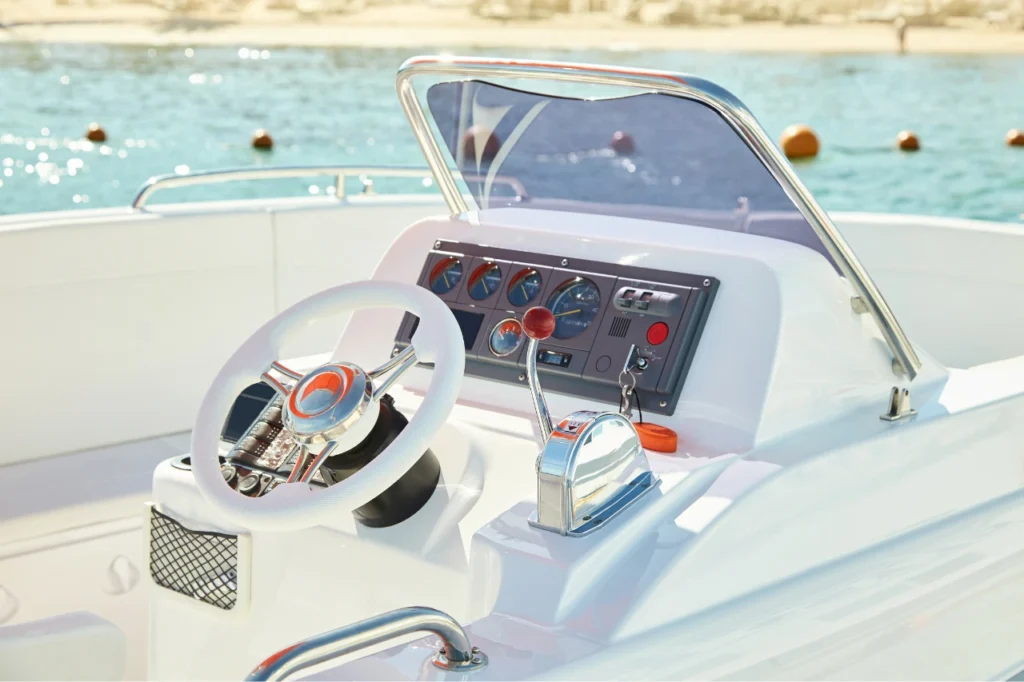
- It just takes a simple toggle on the dash to start the blower.
- Once it starts, take your time to go through the pre-departure checklist before driving on water.
2. Start the Engine
Now that you have turned on the blower to ventilate your engine and verified all the pre-departure checklists, you are all set. Start the engine! Whether your vessel has a key ignition or a push button to start the engine, they all work the same way.
- With key ignition, simply insert the key and turn to start the engine.
- With a push button, you need a fob to hit the button.
Does your engine still not work after going through all these steps? Check your kill switch.
3. Ensure Kill Switch is Activated
Every boat comes with a kill switch. It is a safety equipment that shuts off when the operator is not there on the helm.
- The kill switch is a red knob near the ignition or on the throttle.
- Ensure that the switch is properly activated.
- It is connected to the captain through a small clip attached to a life jacket or vest.
- Draw out the switch and fasten the clip to keep the engine running.
This step can prevent accidents that might be caused by an abrupt engine shutdown.
4. Ensure the Throttle is in Neutral
- Ensure that the throttle is in the neutral position before you hit the engine.
- The 12 o’clock throttle position is usually neutral
If your throttle head is perpendicular to the water surface with the lock engaged, it is in the neutral position.
5. Remove Mooring Lines
Pre-departure checklist done, blower turned on, engine started. You are now good to go! Drive the boat. Hold on, you are still left with one thing before you leave. You need to remove your mooring lines.
- Moored or docked boats are attached to the dock with lines.
- You can either remove the lines by yourself from the deck, or you might need a dock worker to untie the boat and toss the rope ends.
5. Start Driving
Here comes the most awaited moment – Drive your boat!
- Pull forward and leave the dock area.
- Pull the boat out before moving further if it is parked in a covered slip.
- Shift the gear forward or reverse to start moving.
- Hold the throttle control and press the button underneath
- Move the throttle forward or backward until it shifts into gear.
- Release the button.
- Adjust the speed by moving the throttle control.
6. Throttle Adjustment
Now you have got the basic idea that it’s the throttle that makes boat navigation simple.
- Put the throttle in neutral to start
- Move it further to increase the speed
- Pull back on the throttle to slow it down, as your boat will not come to idle automatically.
After learning the fundamentals of driving a boat, let’s dive into the basics of handling it while onboard.
Basics of Steering a Boat
Boat steering is somewhat like car driving, though with a few differences. As mentioned before, various external factors such as wind, waves, or current have a great influence on how your boat might react.
If you expect that turning a wheel will always change your boat’s direction, you need to rethink. It can be a tricky process, especially when you are a first-time driver.
- Turn your boat at a lower speed to have more control.
- Taking a sharp turn at a higher speed can cause passengers to lose their balance.
Slow down! It gives you more control when making high-speed changes.
Slowing Down Your Boat
As your boat does not have brakes, adjust the throttle manually when slowing down. However, it’s easier said than done! The distance at which your boat stops depends on various factors.
- Have a solid understanding of your boat type.
- Know how much space it needs to safely reach at a halt when driving at different speeds.
- To slow down immediately, shift into neutral, stop, and then switch into reverse and raise the throttle.
Reversing Your Boat
- Moving your boat in reverse should be done at a lower speed.
- More effective in other settings, like marinas and docks.
- If you need to reverse in an emergency, just pause after shifting to neutral.
Stopping Your Boat
You must know how to balance properly to successfully stop the boat.
- To pause the boat safely, apply a force equal to the force that is driving you forward.
- Make passengers ready for the transition to prevent a quick fall in forward motion.
Moving Towards More Advanced Skills
Once you have knowledge of the basics, it’s time to learn the advanced skills.
- How to drive the boat at varying speeds
- How to navigate your boat through crowded marinas.
With practice and experience, you will learn how to anticipate the way the boat reacts to the throttle and steering system.
Dive into the World of Boating with Slip stream
Now that you understand the intricacies involved in boat driving, you might be excited to put your knowledge into practice. This is where Slip stream comes to play. It is the first site of its kind in the boating world; whether you want to rent a boat, join a club, find a marina, or connect with a dealer, it’s all here in one spot. It’s free to use, allows you to deal directly with the business, and even offers special deals you won’t get anywhere else.
Conclusion
The bottom line is, before you start, keep in mind that all boats are different, and it takes practice and experience to learn how to drive the boat. Always consider safety your first priority and take your time to learn in calm conditions before heading towards difficult waters.